Resource Library
Post-Traumatic Growth & Resilience
Resources for Trauma-Informed Healing & Well-Being 📚
These are books, videos, and podcasts I have read, listened to, and returned to over time, grounded in trauma-sensitive mindfulness, nervous system function, healing, and well-being. They offer a glimpse into the frameworks of both mindfulness and the healing sciences that are the foundations of Finding My Way Home.
On this page
Well-Being as a Skill
Understanding Trauma
Integration (Interpersonal Neurobiology)
Attachment & the 4 S's
The Nervous System (Polyvagal Theory)
Mindfulness & Trauma-Sensitive Mindfulness
Inner-Compassion
Influenced by Dr. Dan Siegel and the Mindsight Institute, I use the words mindfulness and mindful awareness interchangeably to describe a natural capacity we all share — the simple capacity to notice what is here with kind awareness. On my site, I capitalize Mindfulness and Mindful Awareness when I am referring to them as a formal approach or body of knowledge, and use lowercase when I am describing the capacity itself.
A Surprising Way to Look at Well-Being
I learned from Richie Davidson, PhD (Center for Healthy Minds), that well-being is a skill, something that can be learned and strengthened, much like riding a bike or playing the piano. He identifies four core skills of well-being:
🌱 Awareness
💛 Connection
🔍 Insight
🧭 Purpose
Watch Richie Davidson’s talk describing Well-Being as a Skill
Softly Understanding Trauma
Trauma is not always one single, dramatic event. As Peter Levine, PhD (known for developing the Somatic Experiencing® (SE) approach, a body-oriented method for healing trauma by focusing on attuning to and regulating the nervous system), teaches trauma is not defined by what happened to us, but by what happens inside us — especially when an experience is too much, too soon, too fast (or too little for too long) for the nervous system to process.
The word trauma comes from the Greek word for wound. As Dr. Judith Herman (founding member of the Women's Mental Health Collective), describes trauma can arise from anything that overwhelms our capacity to integrate experience. These unprocessed moments often leave imprints in the nervous system that quietly shape how we feel, respond, and relate.
Trauma, as described by Dr. Gabor Maté (known for developing the Compassionate Inquiry approach), shifts the nervous system toward survival. Trauma disconnects.
While these protective responses help us endure difficult experiences, they can also leave us feeling disconnected from ourselves. Healing is the process of reconnection.
Integration supports this return to wholeness. The resources on this page draw from mindfulness and healing science to support reconnection, regulation, and resilience — helping the nervous system gradually increase capacity to return to balance with less effort, more ease.
Healing involves softly reconnecting with what has been held in the body and nervous system. Through body-based and trauma-sensitive practices, space expands for regulation and release — in its own time — allowing the nervous system to gradually return to its natural rhythm.
Interpersonal Neurobiology & Integration
Interpersonal Neurobiology (IPNB), developed by Daniel J. Siegel, M.D., is an interdisciplinary framework that explores how the mind, brain, and relationships integrate.
In IPNB, well-being is often described using the acronym FACES:
☯ Flexible
🧩 Adaptive
🦋 Coherent (resilient over time)
⚡ Energized
🪨 Stable
Integration links differentiated parts of the system so they work together in harmony. Within an individual, integration connects thoughts, emotions, and bodily sensations. In relationships, it supports empathic connection while honoring individuality.
“Integration is a foundation of health and well-being… Kindness and compassion is integration made visible.” — Dan Siegel
Watch Dr. Dan Siegel describe the flow of Integration
Mindsight: The New Science of Personal Transformation (Book)
Daniel J. Siegel (Foreword by Daniel Goleman)
Introduces the science of awareness and integration, weaving neuroscience with practical application.
Attachment & the 4 S’s
Attachment shapes how safe, connected, and resilient we feel. The 4 S’s of secure attachment, described by Dan Siegel, M.D., include:
Safe — emotional and physical safety
Seen — attunement and understanding
Soothed — support during distress
Secure — an internal sense of worth and stability
I often think of the 4 S’s as water and nutrients that nourish the soil of well-being. 🌱
To learn more, you’re invited to visit my About page.
Mindfulness & Trauma-Sensitive Mindfulness
Mindfulness invites us to pay attention — on purpose, in the present moment — with kindness and curiosity. Trauma-sensitive mindfulness adapts traditional mindfulness practices to support healing — with care for pacing, choice, and capacity. In this way, strong emotions can be met with steadiness, space expands to soothe and settle the nervous system, post-traumatic growth is nurtured, and healing can happen gradually with care to avoid re-traumatization.
Resources (Videos & Books)
Trauma-Sensitive Mindfulness: Practices for Safe and Transformative Healing
by David A. Treleaven
Offers clear, practical guidance for adapting mindfulness practices to support nervous system regulation and healing — with care to avoid overwhelm or re-traumatization.
Trauma-Sensitive Mindfulness: The Power of Self-Nurturing (Video)
Tara Brach, PhD
Explores mindfulness approaches that focus on safety, gentleness, and inner-kindness.
Watch Tara Brach’s talk
Polyvagal Theory
Developed by Stephen Porges, PhD, Polyvagal Theory offers a framework for understanding how the autonomic nervous system (the part of the nervous system that functions largely outside conscious control) responds to cues of safety and threat, shaping our capacity for regulation, connection, and resilience.
The pathways of the vagus nerve carry information between the brain and the body.
Approximately 80% of vagal fibers carry sensory information from the body toward the brain, highlighting the important role of bodily sensation in how we experience and respond to the world.
Three Organizing Principles
Deb Dana, LCSW, has helped translate Polyvagal Theory into accessible language and practice, highlighting three core ideas:
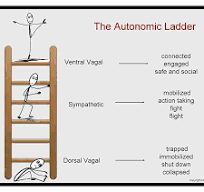
Hierarchy: The autonomic nervous system organizes our responses through three broad states:
Ventral vagal: safe and social; connected, curious, and calm
Sympathetic: mobilized; fight or flight
Dorsal vagal: immobilized; shutdown, numbness, or collapse
Deb Dana offers the metaphor of an autonomic nervous system ladder to help us understand these states and the ways we may move between them in response to cues of safety and threat.
Neuroception: Stephen Porges's term for the nervous system's detection of cues of safety, danger, and threat beneath conscious awareness. Our nervous system may respond before our conscious mind knows why.
Co-regulation: We are wired for connection. The presence, voice, expression, and responsiveness of another person can help support a sense of safety and regulation.
Resources (Videos, Podcasts & Books)
Befriending Your Nervous System (Podcast) — Deb Dana, LCSW
A conversation between Deb Dana and Tami Simon (Sounds True) that explores the complexity and nuance of Polyvagal Theory — with Deb Dana's gift for translating layered science into everyday language.
Listen to Deb Dana and Tami Simon’s conversation
Vagus Nerve Yoga — Easeful Evening Practice (Video) — Arielle Schwartz, PhD
A gentle practice inviting you to soothe your nervous system — unfolding slowly in front of a fireplace. You're invited to move gently, or simply listen. There is no right or wrong — only your nervous system meeting this moment in its own way.
Watch Easeful Evening Practice
Applied Polyvagal Theory in Yoga: Therapeutic Practices for Emotional Health (Book) — Arielle Schwartz, PhD
Wisely and compassionately integrates Polyvagal Theory with yoga and somatic practices to nurture emotional, physical, and spiritual well-being, nervous system regulation, and trauma-informed healing with care to avoid re-traumatization.
Inner Compassion
Inner compassion supports resilience by creating enough safety to try new things, process trauma, and meet challenges with steadiness.
According to Kristin Neff, PhD (Center for Mindful Self-Compassion), self-compassion includes three interconnected elements:
Mindfulness
Common Humanity
Self-Kindness
Fierce Self-Compassion emphasizes protective action, boundary-setting, and meeting your needs — often described as "fierce like a mama bear, protecting her cubs."
Resources (Video & Website)
Listen to Kristin Neff describe harnessing Fierce Self-Compassion
True Refuge: Finding Peace and Freedom in Your Own Awakened Heart (Book)
Tara Brach
Describes how compassion-based mindfulness supports healing and inner stability.